Mercedes CLS320 Boost Problem
By the time Mr C arrived at Shires Garage in Langport, he was running out of ideas.
His Mercedes CLS320 had already passed through the hands of multiple garages, yet none were able to take the issue any further. Each visit ended in the same frustration; no clear diagnosis and no improvement.
The behaviour of the car made the situation even harder to live with. On some days, it felt normal. But on others, it would lose power mid-journey, leaving the Mercedes sluggish and unpredictable. Despite these repeated symptoms, earlier assessments still hadn’t identified what was behind the problem.
For Mr C, it was an exasperating experience. A premium car that should have been smooth and dependable had instead become inconsistent, with no reliable answers from previous inspections.
That’s when he turned to Shires Garage. As trusted Mercedes specialists for drivers in Langport and Taunton, we’re used to the tougher diagnostic challenges; the faults that need patience, experience, and a clear, methodical approach.
It was time to investigate and uncover the cause of the issue.

Beginning the Investigation Into This Mercedes CLS320 Boost Problem
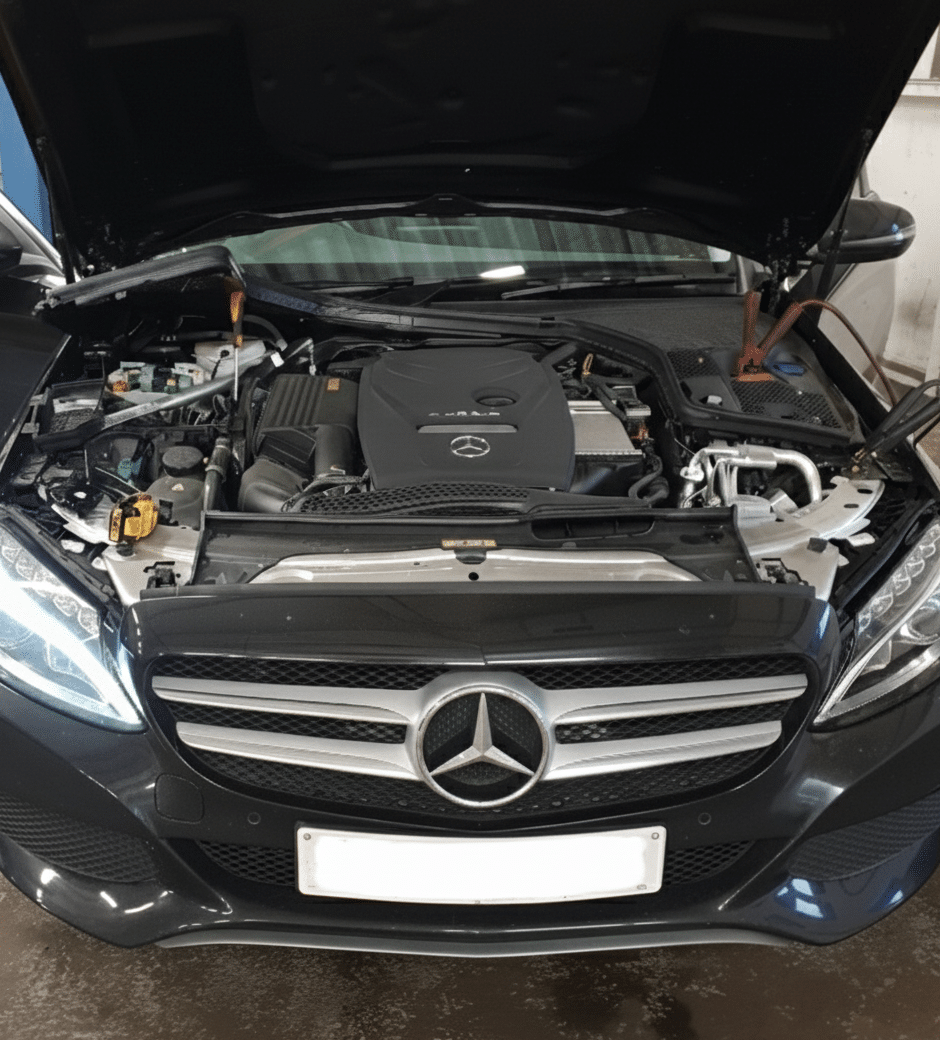
With the Mercedes now at Shires Garage in Langport, we started where every good diagnosis begins: by listening. Before opening the bonnet or connecting any equipment, we asked Mr C to talk us through exactly how the loss of power appeared, how long the issue had been developing, and what he experienced each time it happened. These details help us form a clear roadmap for the steps that follow.
Once we understood the symptoms, we connected our dealer-level diagnostic software to see what the vehicle’s systems had recorded. The scan produced six stored fault codes, each linked to different areas of the engine’s airflow and emissions systems:
- P2626 – DPF soot content too high
The diesel particulate filter had detected excessive soot buildup, showing the system hadn’t been regenerating effectively.
- P2530 – Inlet port shutoff motor short to ground
A fault was logged for the swirl flap actuator, which controls airflow through the inlet manifold to support efficient combustion.
- P2527 – EGR positioner short to ground
The exhaust gas recirculation valve wasn’t receiving the voltage needed to regulate exhaust flow.
- P2514 – Crankcase ventilation line heater short to ground
The heater in the breather line had lost electrical supply.
- P2526 – Charge pressure positioner short to ground
The turbocharger’s actuator wasn’t receiving its voltage feed, affecting how boost pressure is managed.
- P2376 – Throttle valve actuator voltage low
The throttle valve had recorded a low voltage signal, reducing its ability to support airflow and emissions control.
These findings gave us useful clues, but they were only the beginning. When so many related components register faults at the same time, it usually points to a single underlying issue. Our next step was to dig deeper and uncover what was tying these results together.
Taking a Closer Look at This Mercedes CLS320 Boost Problem
With the initial scan completed, the next phase for our Shires Garage technicians was to understand what was linking the stored fault codes. When multiple Mercedes actuators report electrical issues at the same time, the cause is usually linked. To uncover what was going on, we broke the work into clear stages.
Step 1: Reviewing the Shared Electrical Supply
Our first priority was to check whether the components highlighted in the fault scan were drawing voltage from the same feed. Using the wiring information for this model, our technician traced the supply to the turbocharger actuator, the EGR positioner, the swirl flap actuator, the throttle valve actuator and the crankcase ventilation line heater.
All of these components relied on a single fuse-protected supply.
- The fuse on this circuit was visually inspected – we noticed it had blown.
- With the fuse open, every component on that line would have lost its voltage feed together, matching the pattern of electrical faults recorded earlier.
A new fuse was fitted to restore the circuit.
- Several of the logged fault codes cleared straight away, confirming that we were heading in the right direction with the diagnosis.
- A number of faults returned soon after, showing that something on the shared supply was still drawing more current than it should.
This confirmed that the root cause was somewhere along that shared line, so each connected component needed to be inspected closely.
Step 2: Examining the Components on the Circuit
Each actuator and sensor on the shared supply was checked for damage, contamination or signs of electrical failure. Two issues became obvious very quickly:
- Oil contamination on the swirl flap actuator
The actuator that manages airflow within the inlet manifold was coated in oil. Oil entering the housing can damage the internal motor or create electrical shorts, either of which can overload the circuit.
- Mechanical deterioration inside the turbocharger
The turbocharger showed visible damage. The compressor wheel had impact marks, and oil was present where it shouldn’t have been. A failing turbo can push oil into the intake system, which can then reach other components connected to the same area, such as the swirl flap actuator.
The two problems aligned precisely with the symptoms. The oil contamination inside the actuator accounted for the electrical fault on the shared supply, and the turbocharger damage explained why boost pressure came and went during driving.
Step 3: Monitoring the Circuit Under Load
With the likely causes identified, the next stage was to see how the circuit behaved once reactivated. After installing the new fuse, we measured the current draw across each component to confirm whether any further overloads were present.
- When the swirl flap actuator was unplugged, the fuse remained intact. This confirmed the actuator as the source of the electrical issue.
- The turbocharger actuator, although receiving its voltage supply again, still couldn’t operate correctly because of the mechanical damage found earlier.
This confirmed the connection between the logged faults and the issues we had uncovered.
Step 4: Confirming the Correct Repair Approach
Once the investigation had revealed the true causes of the problem, we could plan the repairs needed to get the car performing as it should. The earlier tests had already shown the fault on the shared electrical line, and replacing the fuse during diagnosis had reinstated that supply.
What followed was a repair plan designed to fix each issue we had identified:
- Turbocharger replacement
The failing turbocharger was renewed to restore reliable boost and overall engine performance.
- Swirl flap actuator replacement
A new swirl flap actuator was fitted to stop the electrical fault from recurring on the shared circuit.
- Swirl flap mechanism repair
The swirl flap mechanism was rebuilt using a connecting rod and repair kit, avoiding the expense of a full inlet manifold replacement.
- Intake system clean
The intake system was cleaned down to remove oil residue and support the longevity of the new components.
With the diagnosis confirmed, we knew this set of repairs would address the Mercedes CLS320 boost problem and return the Mercedes to the dependable performance Mr C expected.
A Fully Restored Mercedes and a Happy Customer
Once everything had been rebuilt and our final checks were complete, the Mercedes returned to the level of performance it should have delivered all along. Boost pressure was stable, the engine pulled cleanly, and the inconsistent behaviour that had made the car so frustrating to drive was resolved. It had been a complex issue with several contributing faults, but tackled correctly with a structured diagnostic process and focused repair plan.
Mr C was delighted with the result. After visiting several garages that were unable to take the job further, he was impressed that Shires Garage could identify the real causes and complete the full repair in a single visit. Repairing the swirl flap mechanism rather than replacing the entire inlet manifold also helped keep the overall cost down.
While the work was carried out, Mr C was able to remain mobile using one of our courtesy cars, ensuring minimal disruption to his day-to-day routine. By the time the job was finished, his Mercedes was back to dependable performance and ready for the road again.
Reliable Repairs for Mercedes Performance Issues
If your Mercedes feels low on power, struggles to accelerate smoothly, or shows warning lights that keep coming back, it’s time to have it checked. These symptoms can indicate deeper problems, similar to the complex issues we uncovered in Mr C’s Mercedes CLS320.
At Shires Garage, our technicians are experienced in diagnosing and repairing Mercedes performance faults. Whether your car hesitates under load, fails to build boost, or simply doesn’t drive as it should, we have the tools and expertise to put things right.
Drivers choose us for:
- Free courtesy car while your vehicle is with us
- 12-month parts and labour guarantee
- Dealer-level diagnostic capability
- Access to up-to-date Mercedes technical information
Join the {{review-count}} customers who rate us {{average-rating}} stars on Google.
Call 01458 250570 to book your Mercedes in and get it performing at its best.