Land Rover Fault Code CC1A20-64
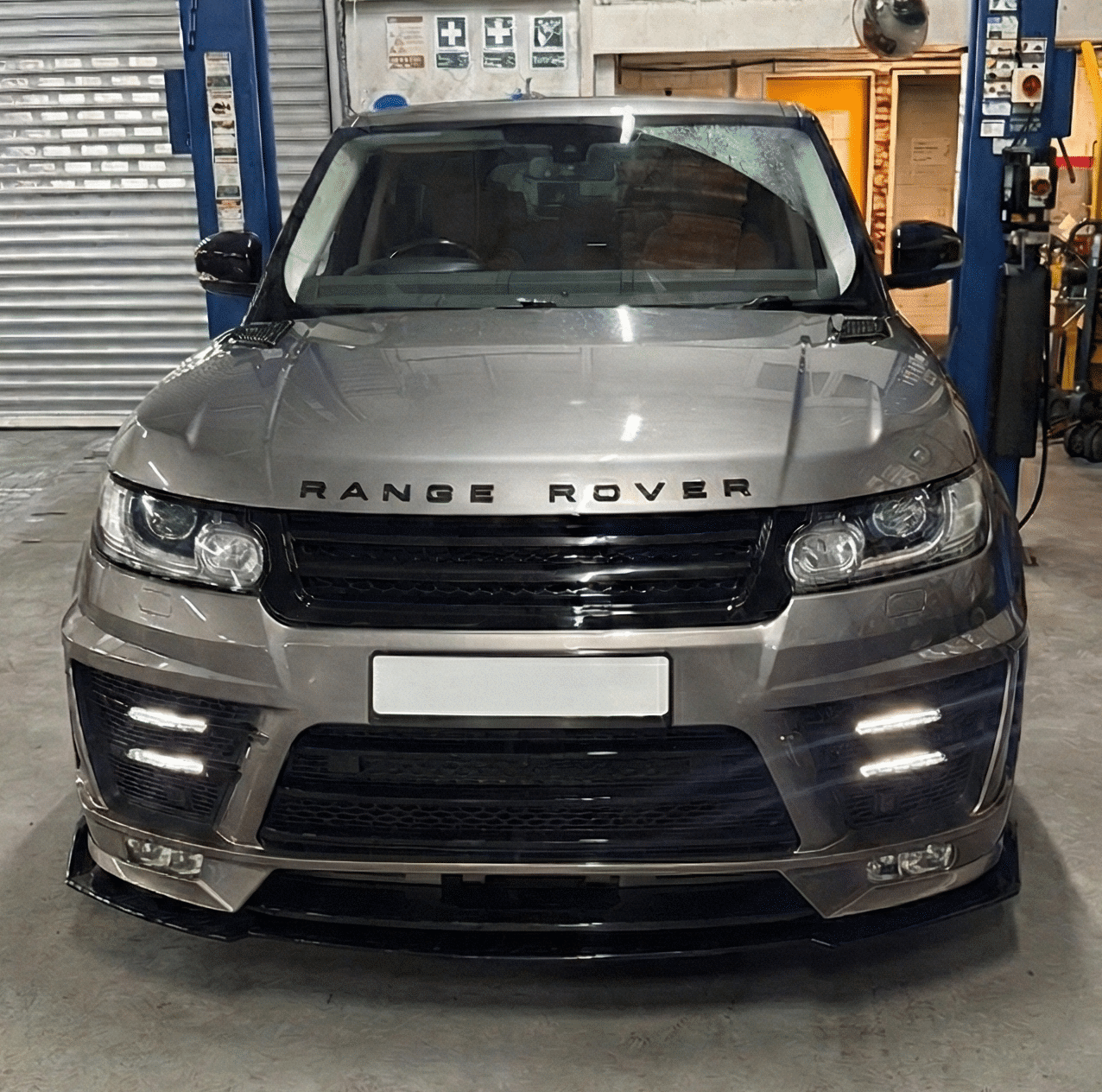
When Mrs T. contacted Shires Garage, she was looking for clarity around two separate issues affecting her Range Rover Sport, both of which had started to raise concerns about how the vehicle was behaving.
The first issue involved a hard brake pedal, most noticeable first thing in the morning after the vehicle had been left overnight. There were no warning lights linked to the braking system, but the change in pedal feel was clear and repeatable, making it difficult to ignore.
Alongside this, the vehicle had begun displaying a suspension warning message stating that only normal height was available. The message appeared intermittently, which made it difficult to understand when the issue might occur or what was triggering it.
With braking performance and suspension control both playing an important role in safety and day-to-day driving, Mrs T. wanted to understand what was behind the symptoms and have them assessed properly. Rather than risk either issue developing further, she contacted Shires Garage in Langport to discuss the concerns and arrange for the vehicle to be checked.
Following that conversation, the Range Rover was booked in so both the braking and suspension issues could be assessed together, allowing a structured investigation to take place.
Initial Assessment of the Brake Pedal and Suspension Warning
When Mrs T.’s Range Rover Sport was brought into Shires Garage in Langport, the first task was to confirm the conditions under which both concerns were occurring. We established that the brake pedal felt noticeably firmer after the vehicle had been left standing, particularly when cold, and we confirmed that the suspension system was restricted to its normal ride height, matching the warning message that had been reported.
Once the symptoms had been verified, the next step was to gather information from the vehicle’s control systems. Manufacturer-level diagnostic equipment was connected so the relevant modules could be checked for any stored fault information.
The scan revealed a fault code linked to the air suspension system:
- CC1A20-64 – Air suspension reservoir pressure increases too slowly
This fault code indicates that the system is unable to build reservoir pressure within the expected time, which can lead the vehicle to limit suspension height as a protective measure.
While this confirmed which system required closer attention, it did not explain why the fault was being triggered. It was also noted that no fault codes were stored in relation to the braking system, despite the clear change in brake pedal feel.
At this stage, the symptoms and affected systems had been identified, but further testing was required. To understand what was happening behind the warning message and the change in pedal behaviour, a more detailed inspection was needed.
Detailed Testing of the Air Suspension and Brake Assistance System
With the initial checks complete, attention turned to identifying the underlying causes of both faults through a structured testing process.
Step 1: Checking the suspension system for air loss
With Land Rover fault code CC1A20-64 present, the first priority was to understand why the suspension system was slow to build pressure. A Land Rover suspension fault like this can have several possible causes, so further testing was required.
One potential cause is air escaping from the system. To rule this out, a structured inspection was carried out across the air suspension components and associated pipework, checking for any signs of leakage.
Testing confirmed that no external air loss was present, allowing the system to be ruled out as the source of the pressure delay.
Step 2: Assessing compressor performance
With air loss eliminated, focus shifted to the compressor itself. The compressor’s ability to generate and store pressure was tested to determine whether it could meet the demands of the suspension system.
Testing showed that the compressor was unable to raise the reservoir pressure within the expected time. When this occurs, the control system limits suspension height to protect the system, which aligns with the warning message being displayed.
This confirmed a Range Rover air compressor fault, rather than an issue elsewhere in the suspension system.
Step 3: Investigating the hard brake pedal
Alongside the suspension testing, the hard brake pedal was investigated separately. This type of symptom points toward the brake assistance system rather than the hydraulic braking components.
The concern was recreated, and the vacuum supply was checked against expected values. The components responsible for creating and retaining vacuum assistance were then tested in stages, allowing sections of the system to be isolated.
Testing showed that vacuum assistance was not being retained as expected when the vehicle was left standing.
The conclusion: Two faults confirmed through testing
By the end of the testing process, clear conclusions had been reached.
- The suspension warning and Land Rover fault code CC1A20-64 were traced to a compressor that could no longer build pressure at the required rate.
- The hard brake pedal was caused by a failing brake assistance servo, allowing vacuum to bleed away while the vehicle was parked.
With both faults confirmed through testing, the next step was to move on to the repair stage.
Resolving the Brake Pedal and Suspension Faults Identified During Testing
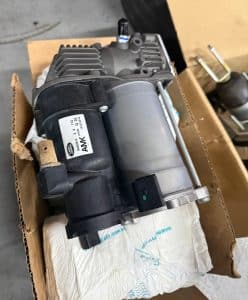
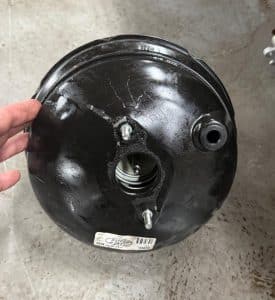
With both issues traced back to confirmed component failures, repairs could move ahead with a clear understanding of what needed to be addressed and why.
Brake assistance servo replacement
The Land Rover hard brake pedal was linked to a loss of vacuum assistance, so attention focused on the brake assistance servo.
Access to the servo was gained in line with manufacturer procedures, allowing the unit to be removed without disturbing the hydraulic braking system. The faulty component was then replaced with an OEM-quality unit, ensuring correct fitment and secure mounting.
Once installed, all vacuum connections were refitted and checked to confirm the system was sealed correctly. Brake pedal response was then assessed to confirm that vacuum assistance was present and operating as expected.
This repair directly addressed the cause of the hard brake pedal Mrs T. had been experiencing.
Air suspension compressor replacement
The suspension warning and Land Rover fault code CC1A20-64 had been traced to poor pressure build-up within the air suspension system, pointing to a compressor that could no longer meet system demands.
The faulty compressor was removed and replaced with a new unit, following manufacturer guidance throughout. Airline connections were refitted carefully to ensure the system could maintain pressure once returned to service.
Dealer-level software was then used to reset and reactivate the suspension system. This allowed the vehicle to recalibrate and restore normal operation, resolving the Range Rover Sport suspension problem and the wider Land Rover suspension fault affecting the vehicle.
System verification and checks
With both repairs complete, the suspension system was checked to confirm it could build and store pressure correctly, addressing the Land Rover air suspension issues that had triggered the warning message. The braking system was also checked to ensure consistent pedal response.
This confirmed that the Range Rover air compressor fault and brake assistance issue had both been resolved.
The Result: Both Issues Resolved in One Visit
With the work completed, Mrs T.’s Range Rover Sport left Shires Garage in a very different condition to when it arrived.
The brake pedal had returned to a normal, consistent feel, resolving the concern that had been most noticeable after the vehicle was left overnight. At the same time, the suspension warning message was no longer present, and full ride height adjustment was available again.
By identifying both faults during the same visit, the correct repairs could be carried out without unnecessary delay. The structured approach taken throughout the inspection and repair process meant the underlying causes were addressed, allowing Mrs T. to leave with a vehicle that was driving as expected once again.
Choose Shires Garage for Accurate Land Rover Fault Diagnosis in Langport
When a Land Rover begins to display warning messages or changes how it drives, it’s important to have it assessed properly. Issues affecting braking or suspension systems need a structured approach to testing, especially on vehicles like the Range Rover Sport.
At Shires Garage in Langport, faults are investigated using a methodical, evidence-led process. This allows the root cause to be identified accurately, rather than relying on assumptions or replacing parts unnecessarily.
By choosing Shires Garage, you benefit from:
- Technicians experienced in diagnosing complex Land Rover faults
- A structured approach to fault-finding and testing
- OEM-quality replacement parts
- A free courtesy vehicle to help minimise disruption
- A 12-month parts and labour guarantee
We’re rated {{average-rating}} stars on Google from {{review-count}} customer reviews.
If your Land Rover is showing warning messages, developing a hard brake pedal, or suffering from a suspension issue, call 01458 250570 and speak to the team today.